Singapore's Education System, Myth and Reality by Rodney King
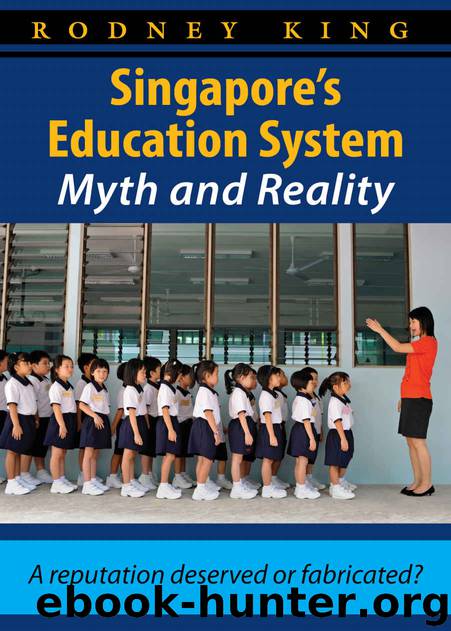
Author:Rodney King [King, Rodney]
Language: eng
Format: azw3
Publisher: Insight Press
Published: 2016-09-11T04:00:00+00:00
Maximising talent is vital for all countries’ success and prosperity, but especially for Singapore where national survival and striving for excellence is an obsession. But its education policies have subverted such aims by reducing its talent levels in ways detrimental to nation-building ends. Such education failings partly explain Singapore’s need to import foreign talent.
5. The Need to Import Foreign Talent
Singapore has seen a growing influx of FTs, especially IT-skilled and junior and middle-level managers, in recent years. Many have become PRs and even citizens. The government claims they are needed to meet Singapore’s skill shortages, especially in technical and middle-management sectors.
Singapore’s skill and higher education levels are well below those of most developed countries, as Chapter 10 showed. This in itself reveals the failure of its education system to meet Singapore’s workforce requirements. Not producing sufficient formerly qualified people is bad enough, but stunting the growth of the broader innovative talents of Singaporeans is worse. This has produced an even more compelling need to recruit foreign talent, either as work-ready employees or as foreign students who can subsequently be bonded to work in Singapore once they have completed their degrees.
Singapore’s hunger for talent has, since the 1990s, resulted in it giving PR and citizenship to soaring numbers of FTs. In 1990, Singapore had 2.62 million citizens and 112,100 permanent residents. In 2000, the respective figures were 2.986 million and 287,500, by 2009 they were 3.2 million and 533,200 and by 2013 were 3.31 million and 531,200.13 In percentage terms, PR numbers had risen from 4.2 per cent of total residential population in 1990 to 9.6 per cent in 2000 and to 16.7 per cent in 2009 though by 2013 had dropped slightly to 16.0 per cent. This has made PRs a sizeable and growing minority much to the consternation of many Singaporeans who see FTs as job rivals. The many thousands of state-subsidised foreign students on scholarships and tuition grants in Singapore have aroused further local anger.
It’s indeed a lamentable education system which has so lobotomised a people’s talent that their rulers feel compelled to import “foreign talents” to make up the deficit. While low birth rates and a modern economy’s voracious needs for talent may partly explain Singapore’s readiness to open-door FT policies a shortage of talent caused by its education policies since 1980 must also be blamed. Singapore’s need to import talent is more compelling than that of other countries with education systems less harmful to the development of student abilities. But importing foreign talent is a short-term fix to a deep systemic problem, largely rooted in the deficiencies of Singapore’s education system.
Download
This site does not store any files on its server. We only index and link to content provided by other sites. Please contact the content providers to delete copyright contents if any and email us, we'll remove relevant links or contents immediately.
The Art of Coaching Workbook by Elena Aguilar(51134)
Trainspotting by Irvine Welsh(21606)
Twilight of the Idols With the Antichrist and Ecce Homo by Friedrich Nietzsche(18599)
Fangirl by Rainbow Rowell(9208)
Periodization Training for Sports by Tudor Bompa(8236)
Change Your Questions, Change Your Life by Marilee Adams(7715)
This Is How You Lose Her by Junot Diaz(6854)
Asking the Right Questions: A Guide to Critical Thinking by M. Neil Browne & Stuart M. Keeley(5734)
Grit by Angela Duckworth(5574)
Red Sparrow by Jason Matthews(5446)
Paper Towns by Green John(5157)
Room 212 by Kate Stewart(5087)
Ken Follett - World without end by Ken Follett(4701)
Housekeeping by Marilynne Robinson(4418)
The Sports Rules Book by Human Kinetics(4365)
Double Down (Diary of a Wimpy Kid Book 11) by Jeff Kinney(4252)
Papillon (English) by Henri Charrière(4235)
The Motorcycle Diaries by Ernesto Che Guevara(4069)
Exercise Technique Manual for Resistance Training by National Strength & Conditioning Association(4048)
